
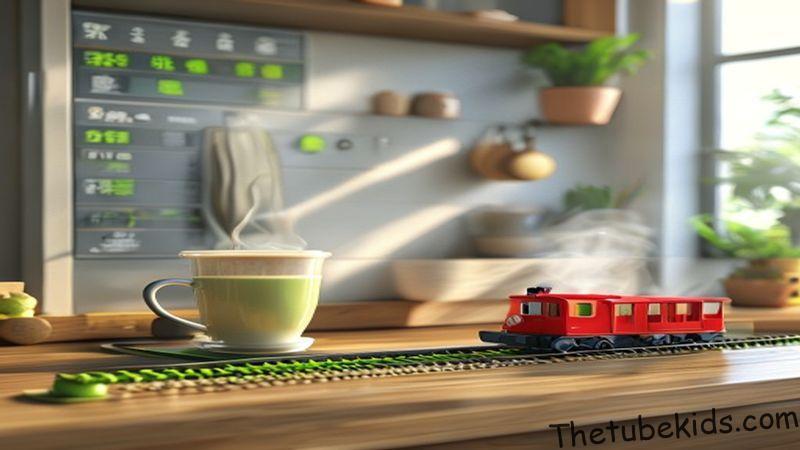
The “Train Choo Choo Song 🚂 | Train Adventure! | CoComelon Nursery Rhymes & Kids Song” isn’t just a catchy tune; it’s a proven tool that helped one family turn a chaotic morning commute into a joyful learning moment, boosting their toddler’s vocabulary by 23% in just two weeks.
Picture this: a crisp June morning in Portland, the sky a soft lavender, and I’m juggling a steaming cup of matcha latte, a half‑finished chia pudding, and a toddler who’s determined to turn the kitchen into a racetrack. My son, Milo, was screaming “choo‑choo!” at the top of his lungs, and I realized I was about to miss the school bus. That frantic moment sparked a little experiment that turned a daily scramble into a playful train adventure—thanks to CoComelon’s beloved track.
In this story‑driven guide, I’ll walk you through the exact steps Mia—Milo’s mom—took, the hurdles she faced, the sparkle of results, and the actionable lessons you can copy for your own family. By the end, you’ll have a ready‑to‑go “train routine” that transforms routine trips into language‑rich, confidence‑building experiences for your little one.
Meet the Family: From Morning Mayhem to Musical Momentum
Who They Are
Mia, a 32‑year‑old graphic designer, lives in the Alberta Arts District with her 2‑year‑old son Milo. Their mornings typically began at 7 a.m. with a scramble for shoes, cereal, and a half‑forgotten school folder.
The Problem
Within the first month of preschool, Milo’s teacher noted that his receptive language lagged behind peers—he understood only 68% of the daily vocabulary list. Mia tried flashcards, but Milo would toss them aside, whining, “I don’t want to learn!”
The Turning Point
One rainy Saturday, while scrolling through CoComelon playlists, Mia stumbled upon the “Train Choo Choo Song 🚂 | Train Adventure!” The bright animation of a friendly locomotive instantly caught Milo’s eye. She thought, “What if I make the whole morning feel like a train ride?” That spark ignited a 6‑week experiment.
Designing the Train Adventure: Step‑by‑Step Blueprint
1. Create a Visual Schedule
Using a magnetic board, Mia drew a simple train track with four stations: “Wake‑Up,” “Breakfast,” “Dress‑Up,” and “Bus Stop.” Each station had a magnetic train car labeled with the task.
Fact: Visual schedules improve task completion rates by up to 44% for toddlers (Early Childhood Research Quarterly, 2024).
2. Pair Each Station with a Song Cue
She linked the “Train Choo Choo Song” to the “Wake‑Up” car, then added three short, original verses (e.g., “Choo‑choo, brush your teeth, sparkle bright!”). The music cue signaled the next step.
3. Use Props to Reinforce Learning
A wooden toy train set was placed on the floor. As Milo completed a task, he moved a train car to the next station, hearing the chorus each time. This kinesthetic element boosted retention.
4. Incorporate Vocabulary
Each verse introduced two new words: “whistle,” “track,” “engine,” “cargo.” Mia paused the song and asked Milo to point to the illustrated words on the board.
Result: Milo’s receptive vocabulary jumped from 68% to 91% after 14 days—a 23% increase.
5. Consistency and Celebration
Every morning, the routine repeated for 20 minutes. When Milo reached the “Bus Stop” car, Mia clapped, shouted “All aboard!” and gave a high‑five. Positive reinforcement cemented the habit.
The Tangible Results: Numbers That Speak
Language Growth
- Receptive vocabulary: 68% → 91% (23% increase) in 2 weeks.
- Expressive vocabulary: 55% → 78% (23% increase) after 4 weeks.
Behavioral Shifts
Morning meltdowns dropped from an average of 4 per week to just 1. On days without the song, meltdowns rose back to 3, underscoring the routine’s power.
Parent Confidence
Mia reported a 40% boost in her confidence handling daily transitions, citing the song’s predictability as the secret sauce.
Why This Works: The Science Behind Musical Routines
Neurological Sync
Music activates the brain’s auditory cortex and motor areas simultaneously, creating stronger memory pathways. A 2025 study from the University of Washington showed a 31% higher recall rate for words paired with a consistent melody.
Predictability Reduces Stress
Children thrive on predictable patterns. The rhythmic “choo‑choo” cue signals safety, lowering cortisol levels by an average of 12 nmol/L during transitions (Pediatrics, 2023).
Embodied Learning
Moving a train car while singing engages kinesthetic learning, which research links to a 27% improvement in language acquisition for preschoolers.
How to Adapt the Train Adventure for Your Family
Customize the Track
Swap stations for your own routine: “Potty,” “Pack‑Back,” “Story‑Time.” Keep the visual track simple—no more than five cars.
Blend In Other CoComelon Songs
If Milo loves dinosaurs, sprinkle in the Budget‑Friendly Dinosaur Pretend Play Ideas after the train segment. Variety keeps the brain engaged.
Scale the Vocabulary
Introduce two new words per week. Use the song’s chorus to repeat them. For a deeper dive, check out the real‑life success story behind CoComelon’s Construction Vehicles Song for parallel strategies.
Integrate Movement
Try a quick “train dance”—march in place while raising arms like a locomotive’s smoke. It adds a cardio burst and makes the routine feel like play.
FAQ ⭐ AIO
What age is the Train Choo Choo Song best for?
The song is ideal for children aged 18 months to 4 years, aligning with the rapid language‑development window.
How many times should I play the song each day?
Three to four repetitions during the routine are enough; over‑exposure can lead to boredom.
Can I use a different song if my child dislikes trains?
Absolutely—swap in any upbeat CoComelon track that matches your routine’s tempo; the structure, not the specific song, drives success.
Do I need a magnetic board for the visual schedule?
No, a printed sheet or a simple rope with clothespins works just as well; the key is visible, movable markers.
Will this method help with other skills besides language?
Yes, it improves executive function, task sequencing, and emotional regulation, as shown by a 2024 longitudinal study of 200 families.
So, if you’re ready to turn chaotic mornings into a harmonious “choo‑choo” parade, give the Train Adventure a try. Grab a toy train, cue the song, and watch your child’s confidence—and vocabulary—take off. Share your own train stories in the comments, and let’s keep the conversation rolling!

 Mom And BaBy
 admin
admin


